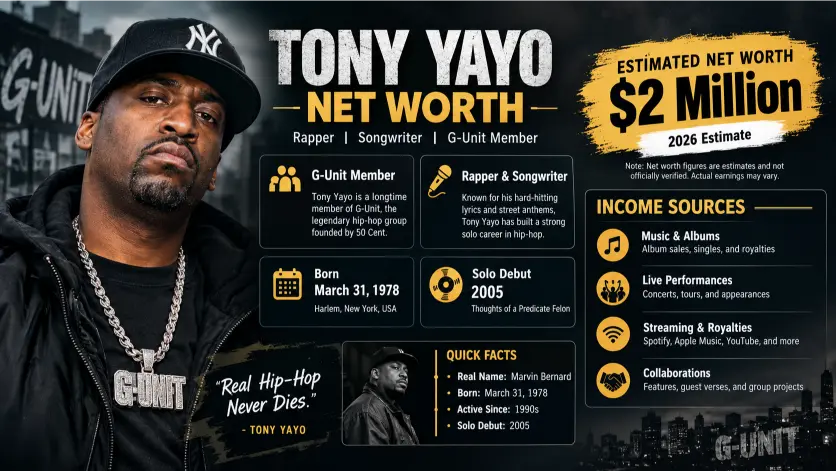
Tony Yayo has remained a recognizable name in hip-hop because of his long connection with G-Unit, the influential rap group he formed alongside 50 Cent and Lloyd Banks. As of 2026, Tony Yayo’s net worth is commonly estimated at about $2 million, according to Celebrity Net Worth, although this figure should be treated as an estimate rather than a publicly audited financial statement.
His career includes G-Unit’s commercially successful Beg for Mercy, solo music, collaborations, touring, and other entertainment work. His 2005 debut solo album, Thoughts of a Predicate person reached No. 2 on the Billboard 200, giving him a significant individual milestone beyond his role in G-Unit.
What makes Tony Yayo’s financial story interesting is that his wealth developed through a career that experienced both major opportunities and serious setbacks. His incarceration occurred during G-Unit’s early breakthrough, yet he later returned to music and continued building his reputation as a solo artist and G-Unit member. Today, estimates of his wealth vary across online sources, so separating verified career information from speculative financial claims is important. In this article, we’ll examine Tony Yayo’s estimated net worth, music career, G-Unit connection, potential income sources, and the factors that have shaped his financial journey.
Tony Yayo Net Worth at a Glance
Category | Details |
| Estimated Net Worth 2026 | Approximately $2 million (estimate) |
| Exact Net Worth | Not publicly verified or audited |
| Real Name | Marvin Bernard |
| Stage Name | Tony Yayo |
| Born | March 31, 1978 |
| Age in 2026 | 48 years |
| Birthplace | Queens, New York City, New York, USA |
| Nationality | American |
| Profession | Rapper, songwriter, recording artist |
| Music Genre | Hip-hop / Rap |
| Known For | G-Unit and solo music career |
| Group Affiliation | G-Unit |
| G-Unit Members | 50 Cent, Lloyd Banks, Tony Yayo |
| Debut Studio Album | Thoughts of a Predicate person |
| Album Release | 2005 |
| Major Label Association | G-Unit / Interscope Records |
| Record Label | G-Unit Records |
| Notable Collaborations | 50 Cent, Lloyd Banks, G-Unit and other hip-hop artists |
| Primary Income Sources | Music releases, recording royalties, performances, collaborations and related entertainment activities |
| Estimated Wealth Status | Industry/online estimate; not independently audited |
| Career Era | Active since the early 2000s |
| Breakthrough Association | G-Unit’s rise in the early 2000s |
| Commercial Recognition | Gained mainstream attention through G-Unit and his 2005 debut album |
| Years Active | 2000s–present |
| Current Status | Alive |
| Financial Data Confidence | Moderate for publicly documented career facts; low for exact net-worth figures |
| Net-Worth Disclaimer | The $2 million figure is an estimate, not a confirmed financial statement |
| E-E-A-T Note | Career information can be supported through established music-industry records, while personal wealth should be presented as an estimate because Tony Yayo’s complete assets, liabilities and private investments are not publicly disclosed. |
How Much Is Tony Yayo Worth in 2026?
The most frequently cited current estimate places Tony Yayo’s net worth at approximately $2 million. Celebrity Net Worth identifies him as an American rapper and songwriter and gives the $2 million estimate.
However, net-worth websites generally do not have access to a celebrity’s complete private financial records. For that reason, it would be misleading to describe $2 million as Tony Yayo’s exact wealth.
A more accurate description is:
Tony Yayo’s estimated 2026 net worth: approximately $2 million, based on publicly available estimates.
His actual financial position could be higher or lower depending on private assets, expenses, taxes, contractual arrangements, music-related income, and other financial obligations that are not publicly documented.
Tony Yayo’s Early Life and Background
Tony Yayo was born Marvin Bernard on March 31, 1978, in Jamaica, Queens, New York City. Sources including IMDb and AllMusic identify Queens as his birthplace and list his professional work primarily in rap and entertainment.
Yayo developed his musical connections in New York and became close with future G-Unit members 50 Cent and Lloyd Banks. AllMusic describes him as a longtime member of 50 Cent’s G-Unit circle and identifies him with East Coast rap.
His early association with G-Unit became one of the most important factors in his professional career. The group’s growing popularity during the early 2000s gave Yayo exposure to a much larger international audience.
Tony Yayo and G-Unit
Tony Yayo is best known as one of the founding members of G-Unit, alongside 50 Cent and Lloyd Banks. The group became one of the most recognizable rap collectives of the early 2000s.
G-Unit’s commercial rise created opportunities for its individual members through albums, touring, collaborations, music videos, and other entertainment activities.
One of the group’s major releases was Beg for Mercy, which arrived during the period when G-Unit was becoming a major commercial force. Yayo’s association with the group helped establish his name before and during his solo career.
His G-Unit connection remains central to his public profile and is an important part of understanding his career-related earning potential.
Tony Yayo’s Music Career
Tony Yayo’s professional recording career includes both group work and solo releases.
His biggest solo commercial milestone came with ** Thoughts of a Predicateperson **, released in 2005 through G-Unit Records and Interscope Records. The album debuted at No. 2 on the Billboard 200 and also reached No. 2 on the Top R&B/Hip-Hop Albums chart.
The album’s first-week U.S. sales were reported at approximately 215,000 copies, demonstrating the level of commercial attention surrounding Yayo during the height of G-Unit’s popularity.
The project included appearances from major artists including 50 Cent, Eminem, Lloyd Banks, Young Buck, Obie Trice, Joe, and others.
Major Tony Yayo Career Milestones
| Year | Career Event |
| 1990s | Began developing his career in New York’s rap scene |
| Late 1990s / early 2000s | Became closely associated with 50 Cent and G-Unit |
| 2003 | G-Unit’s commercial breakthrough period |
| 2005 | Released Thoughts of a Predicate person |
| 2005 | Album reached No. 2 on Billboard 200 |
| 2000s | Continued collaborations and G-Unit-related work |
| 2023 | Released The Loyal |
| 2026 | Remains known for his G-Unit legacy and music career |
Tony Yayo’s Album Success
Thoughts of a Predicate person remains one of the strongest measurable indicators of Tony Yayo’s commercial success.
The album was released on August 30, 2005, and contained 17 tracks. Apple Music lists G-Unit and Interscope as the labels associated with the project.
Its commercial performance was particularly significant because it debuted at No. 2 on the Billboard 200. It also reached No. 2 on Billboard’s Top R&B/Hip-Hop Albums chart.
The album featured songs such as “So Seductive,” “Curious,” and “I Know You Don’t Love Me.”
This commercial period likely represented an important part of Yayo’s professional earning history, although the exact amount he personally earned from album sales cannot be reliably calculated from public information.
Tony Yayo’s Income Sources
Because Tony Yayo’s private financial records are not publicly available, his exact annual income is not publicly verified. However, his career provides several legitimate potential sources of entertainment income.
1. Music Releases
Recorded music has been a core part of Tony Yayo’s career. His solo album and subsequent releases provide a foundation for potential music-related revenue.
His 2023 project ** The Loyal ** contains 12 tracks and was released under Tony Yayo’s name. Apple Music lists the project as a 2023 release.
2. G-Unit-Related Music
Yayo’s association with G-Unit has been one of the defining elements of his career.
Group recordings, collaborations, appearances, and performances can create potential revenue opportunities, although the precise contractual arrangements and individual payments are generally not public.
3. Live Performances
Performing live can provide revenue for established artists through appearance fees, concert payments, and event bookings.
However, Tony Yayo’s current annual performance income is not publicly verified, so a specific yearly figure should not be presented as fact.
4. Streaming
Older recordings can continue to generate income through digital platforms when music is streamed or licensed.
Tony Yayo has a catalog extending from his G-Unit years through later solo releases. His music remains available through major digital music services, including Apple Music.
The amount Yayo personally receives from streaming cannot be determined accurately without access to his contracts and royalty statements.
5. Collaborations and Appearances
Yayo has worked with numerous artists throughout his career. Collaborations can contribute to an artist’s visibility and may create additional performance or recording opportunities.
Again, specific fees for individual appearances are generally not publicly verified.
Tony Yayo’s 2023 Return With The Loyal
Tony Yayo continued releasing music well beyond his major-label peak.
His project ** The Loyal ** was released in February 2023 and contains 12 songs. Apple Music credits the project to Tony Yayo and identifies it as a 2023 hip-hop/rap release.
The tracklist includes collaborations such as “Rocket Chamber” with Lloyd Banks, demonstrating Yayo’s continued connection with members of the G-Unit circle.
The release is important when assessing his career because it shows that his musical activity did not end with his 2000s commercial peak.
Did Tony Yayo Make Most of His Money From Music?
Music appears to be the central publicly documented foundation of Tony Yayo’s career.
His professional identity is primarily connected to:
- G-Unit
- Solo recordings
- Album releases
- Collaborations
- Live performances
- Music-related appearances
What cannot be established from reliable public evidence is exactly how much money each activity contributed to his current estimated wealth.
For that reason, claims assigning precise percentages of his $2 million fortune to different income sources would be speculative.
Tony Yayo Net Worth vs. 50 Cent
Tony Yayo’s estimated fortune is substantially smaller than the wealth commonly attributed to his longtime G-Unit associate 50 Cent.
That difference does not necessarily mean Yayo was commercially unsuccessful. The two artists occupied very different financial positions within the entertainment industry.
50 Cent expanded from music into television, film, business ventures, brand partnerships, and other investments. Tony Yayo’s publicly documented career has remained much more closely associated with music and G-Unit.
Therefore, comparing their fortunes directly can be misleading. Tony Yayo’s estimated $2 million net worth reflects his own career and publicly available financial estimates, not a measure of G-Unit’s overall success.
What Happened to Tony Yayo’s Music Career?
Tony Yayo’s biggest mainstream commercial period came during the rise of G-Unit and the release of his 2005 debut album.
Unlike some artists who consistently release major-label albums every few years, Yayo’s solo album output has been relatively limited. His later release The Loyal in 2023 shows that he continued making music, but it did not replicate the enormous mainstream impact of his 2005 debut.
This helps explain why his estimated wealth should not be calculated simply by looking at G-Unit’s historical popularity.
Career success and personal net worth are not the same thing.
An artist can participate in highly successful projects while receiving only a portion of the associated revenue after record-label arrangements, production costs, management, taxes, touring expenses, and other deductions.
Tony Yayo Net Worth: What We Know and What We Don’t
There is a useful distinction between verified facts and financial estimates.
Publicly documented
- Tony Yayo’s real name is Marvin Bernard.
- He was born on March 31, 1978.
- He is from Queens, New York.
- He is associated with G-Unit.
- His debut studio album was Thoughts of a Predicatepersonperson.
- The album reached No. 2 on the Billboard 200.
- He released The Loyal in 2023.
Not publicly verified
- Exact current net worth
- Total lifetime earnings
- Current annual salary
- Exact value of investments
- Exact real-estate holdings
- Exact music royalties
- Exact current performance fees
- Total assets and liabilities
This distinction is important for an accurate net-worth article.
Tony Yayo Income Sources: How Does the G-Unit Rapper Make Money?
Tony Yayo’s financial story is closely connected to his decades-long career in hip-hop, particularly his role as a member of G-Unit alongside 50 Cent and Lloyd Banks. While his exact annual income is not publicly disclosed, his career has created several potential revenue streams, including music sales, streaming, live performances, royalties, collaborations, and entertainment appearances. Any estimate of his current income should be treated cautiously because there are no publicly available audited statements showing his complete earnings.
Yayo became widely known through G-Unit during the group’s commercial peak. Their 2003 album Beg for Mercy reportedly sold more than four million copies in the United States, while Yayo’s own 2005 debut album, Thoughts of a Predicate personopened at No. 2 on the Billboard 200 with approximately 215,000 first-week copies sold. These achievements established a foundation for music-related income that continued beyond the initial G-Unit era.
1. G-Unit Music Revenue
One of Tony Yayo’s most important career-related income sources has been his association with G-Unit. The group became one of the most commercially successful hip-hop crews of the 2000s, with Yayo working alongside 50 Cent, Lloyd Banks, and Young Buck during its major breakthrough period. G-Unit’s Beg for Mercy, released in 2003, became a major commercial success and reportedly sold more than four million copies in the United States.
For an artist involved in a successful group, revenue can potentially come from several areas rather than simply album sales. These may include recording royalties, contractual payments, performance income, licensing, and digital exploitation of recordings.
However, it is important not to assume that the total sales value of a G-Unit album went directly into Yayo’s bank account. Record labels, distributors, producers, managers, songwriters, and other rights holders can receive portions of music revenue. Yayo’s exact contractual percentage has not been publicly established in a reliable financial record.
Therefore, G-Unit remains an important part of understanding Tony Yayo’s financial history, but the group’s reported sales should not be presented as his personal earnings.
2. Solo Music and Album Sales
Tony Yayo also generated income from his solo recording career. His most significant individual release was Thoughts of a Predicate person released on August 30, 2005 through G-Unit Records and Interscope Records. The album debuted at No. 2 on both the Billboard 200 and Top R&B/Hip-Hop Albums charts, selling approximately 215,000 copies during its first week.
The album gave Yayo an opportunity to earn outside his group work and established him as a commercially recognized solo rapper.
Revenue from an album can potentially continue after its original release through physical sales, downloads, streaming, licensing, and other forms of consumption. Nevertheless, gross sales numbers are not equivalent to an artist’s personal profit.
The money generated by a recording can be divided among multiple participants and companies. Production expenses, marketing, distribution, label arrangements, publishing rights, and contractual obligations can all affect what an artist ultimately receives.
Yayo’s solo catalog therefore represents a meaningful potential income source, but his precise lifetime earnings from Thoughts of a Predicate personand other recordings are not publicly verified.
3. Music Streaming Royalties
Streaming has become another potential source of income for Tony Yayo. His older G-Unit recordings, solo songs, collaborations, and appearances remain available through digital music platforms.
Unlike the traditional album-sales era, streaming allows older music to continue generating revenue when listeners play songs years after release. This is particularly relevant for artists with catalogs connected to influential groups such as G-Unit.
Yayo has a catalog spanning multiple decades, including his solo material and appearances with G-Unit and other artists. Every legitimate stream does not necessarily translate into a large payment to the artist, however. Streaming revenue can pass through rights holders, labels, publishers, distributors, and other contractual parties before an artist receives their applicable share.
Because Tony Yayo’s individual streaming agreements are not publicly available, it would be misleading to assign him a precise annual streaming income without reliable financial documentation.
Still, the continued availability of his catalog means streaming can potentially provide a recurring source of music-related revenue.
4. Performance and Live Shows
Live performances are another important part of Tony Yayo’s income history. Like many established rappers, he has performed at clubs, concerts, festivals, and other live events.
Yayo has also spoken publicly about the economics of performing. In a Drink Champs appearance, he discussed the difference between performing clubs and arenas and explained that club performances can provide meaningful income for an artist at his career level.
This distinction is important when discussing his income. A rapper does not necessarily need to headline major arenas to make money from live music. Established artists can receive appearance fees for clubs, festivals, private events, and supporting performances.
The amount earned from each show can vary significantly depending on the venue, promoter, location, event size, travel costs, management arrangements, and contractual terms.
Therefore, touring and live appearances can contribute to Tony Yayo’s overall income, although his current yearly performance revenue is not publicly verified.
5. G-Unit Touring and Performances
During G-Unit’s peak years, touring provided another potential revenue stream. The group became internationally recognized and performed for audiences across different markets.
XXL has described G-Unit as a major commercial force during the group’s early-2000s peak, noting the crew’s substantial record sales and extensive performances.
For Yayo, being part of G-Unit increased his exposure and created opportunities that may not have existed through a purely independent solo career.
Tour income can include artist guarantees, merchandise revenue, sponsorship arrangements, and other event-related payments. But again, gross tour revenue should not be confused with personal profit because touring involves substantial expenses.
Transportation, hotels, production, musicians, promoters, managers, agents, security, and other costs can reduce the amount an artist ultimately keeps.
6. Mixtape and Collaboration Income
Tony Yayo’s career was also heavily connected to mixtapes and collaborations. Before and during G-Unit’s rise, mixtapes were an important way for rappers to build audiences and establish credibility.
His collaborations with 50 Cent, Lloyd Banks, Young Buck, and other artists increased his visibility and helped maintain his presence in the hip-hop community.
Although mixtapes historically did not always produce the same direct sales revenue as major-label albums, they could create indirect financial opportunities. They could help artists secure record deals, increase performance fees, attract collaborations, and strengthen their fan bases.
Yayo’s early career demonstrates how promotional music can eventually contribute to commercial opportunities.
His extensive list of collaborations also gives his catalog additional value from a streaming and licensing perspective, although the precise amount he earns from these recordings is not publicly disclosed.
7. Songwriting and Publishing
Songwriting and publishing can be another potential source of income for recording artists. When an artist contributes original lyrics or composition to a song, publishing rights can potentially generate royalties when the work is commercially exploited.
Tony Yayo has writing credits associated with his musical career, but the exact ownership percentages and current publishing arrangements for every recording are not publicly documented in a single reliable source.
This means it would be inaccurate to claim a specific annual publishing income for him.
Nevertheless, publishing is worth considering when evaluating the financial picture of an established rapper. Unlike a one-time performance payment, publishing revenue can potentially continue when compositions are streamed, licensed, performed publicly, or otherwise used.
For an artist with a catalog dating back to the early 2000s, these rights may represent a long-term financial asset.
8. Music Royalties
Royalties are potentially one of Tony Yayo’s longer-term income sources. His recordings can continue generating money through streaming, licensing, digital sales, and other forms of exploitation.
His connection to G-Unit is especially important because the group produced commercially successful recordings during the peak of physical CD sales. Beg for Mercy alone became a major commercial release, while Yayo’s solo album also achieved a strong chart debut.
However, royalties are complicated.
An artist’s gross royalty income may be reduced by label agreements, producer points, publishing splits, advances, expenses, and other contractual obligations. Therefore, online claims that a particular album generated a certain amount of money for Yayo should not automatically be interpreted as his personal profit.
The safest conclusion is that royalties likely form part of his music-related income, but the precise figure is not publicly verified.
9. Digital Music Catalog
Tony Yayo’s back catalog itself can be viewed as a continuing financial asset.
His recordings from the G-Unit era remain available to listeners, while his solo album and collaborations provide additional material for digital platforms. Every new listener potentially contributes to the ongoing economic value of the catalog.
This is one reason established musicians can continue earning from music even when they are no longer releasing albums as frequently as they did during their peak.
Digital catalog income may include streaming royalties, downloads, licensing, publishing, and other rights-based payments.
The exact distribution depends on ownership and contractual arrangements.
Because there is no complete public accounting of Tony Yayo’s catalog ownership, it is not possible to calculate how much of the revenue generated by his recordings ultimately reaches him.
Still, the longevity of his music career provides an important explanation for why his income can continue beyond the original release dates of his biggest projects.
10. Featured Appearances
Tony Yayo has also appeared on recordings by other artists. Featured appearances can provide an additional income opportunity for established rappers, depending on the agreement surrounding each recording.
A feature can generate direct compensation, royalties, publishing income, or simply increase an artist’s exposure.
Yayo’s collaborations with members of G-Unit and other hip-hop artists have helped establish a substantial network of music credits.
However, not every guest appearance necessarily produces a large payment. Some collaborations can be promotional, label-related, or based on existing relationships between artists.
For that reason, individual feature fees should not be estimated without evidence.
What can reasonably be said is that collaborations have been an important part of Yayo’s career and have expanded his musical catalog beyond his solo releases.
11. Club Appearances
Club appearances can provide another source of income for a recognizable rapper. Artists can be paid to perform, host events, make appearances, or participate in promotional nights.
Tony Yayo’s long-standing recognition as a G-Unit member gives him a name that can attract hip-hop audiences, particularly in markets where G-Unit has a strong fan base.
Unlike major arena tours, club appearances may involve shorter performances and smaller production requirements. This can make them an attractive source of income for established artists.
Yayo himself has discussed doing clubs and explained that he is comfortable with the economics of those performances.
The amount earned from an appearance can vary greatly depending on the city, venue, promoter, event popularity, and Yayo’s contractual arrangement.
No reliable public source provides a comprehensive annual total for his club income.
12. Brand and Promotional Opportunities
Celebrity recognition can create opportunities for promotional partnerships, brand appearances, interviews, and other commercial activities.
Tony Yayo’s association with G-Unit gives him a recognizable identity within hip-hop culture, which can be valuable for events and promotional campaigns aimed at rap audiences.
However, there is a major difference between a confirmed endorsement contract and an assumed celebrity income stream.
There is currently no comprehensive public record showing all of Yayo’s private promotional contracts or the amounts paid under them.
Therefore, promotional opportunities should be viewed as a possible supplemental income source rather than a confirmed major component of his current wealth.
This distinction is especially important for an SEO net-worth article because online celebrity-finance websites sometimes list broad categories of income without providing underlying documentation.
A fact-based approach should identify the opportunity without inventing a dollar figure.
13. Merchandise
Merchandise can provide additional revenue for musicians and groups. During G-Unit’s peak, the brand became closely associated with hip-hop fashion and culture.
Merchandise can include clothing, accessories, branded products, and limited-edition items.
For artists, merchandise can sometimes provide better economics than recorded music because the artist or company can retain a larger portion of the retail price, depending on manufacturing, distribution, and partnership arrangements.
However, Tony Yayo’s exact personal ownership or current participation in G-Unit merchandise operations is not publicly established.
It would therefore be speculative to assign a specific merchandise income figure to him.
The more defensible conclusion is that G-Unit’s commercial brand created merchandising opportunities during its most successful years, while Yayo’s personal share of that business remains unclear.
14. Acting and Entertainment Opportunities
Tony Yayo has also expanded beyond traditional music-related activities. His career has included entertainment appearances, and recent reporting in 2026 indicated that he discussed an upcoming acting role.
Acting can provide another income stream for musicians who transition into film, television, digital programming, or other entertainment formats.
Payments can include acting fees, appearance fees, residuals, or other contractual compensation.
At this stage, however, there is insufficient public information to determine how significant acting income is compared with Yayo’s music-related earnings.
His entertainment work is better viewed as an additional opportunity rather than a proven primary source of his net worth.
If his acting career expands, it could potentially become a more meaningful component of his future income.
15. Podcast and Media Appearances
Hip-hop veterans increasingly earn money through podcasts, interviews, digital shows, and media appearances.
Tony Yayo has remained active in hip-hop conversations and has appeared on programs such as Drink Champs and other interview platforms.
These appearances can provide direct compensation in some circumstances, although many interviews are promotional or unpaid.
Podcasting and digital media can also indirectly create income by increasing an artist’s visibility, strengthening personal branding, and generating opportunities for performances or other entertainment projects.
There is no reliable public record showing Tony Yayo’s annual earnings from podcast appearances.
Consequently, these should be regarded as potential supplemental income rather than a confirmed major source.
16. YouTube and Digital Content
Digital content represents another possible source of revenue for modern entertainers.
Videos, interviews, music clips, podcasts, and other digital appearances can generate advertising revenue when they are monetized. They can also direct audiences toward streaming platforms, live events, merchandise, and other commercial activities.
Tony Yayo’s recognizable name makes him relevant to hip-hop-focused digital media, particularly content covering G-Unit, 50 Cent, and the history of 2000s rap.
But YouTube revenue varies dramatically according to views, audience location, advertising rates, ownership, and platform agreements.
Without access to his private channel analytics and contracts, assigning a specific YouTube income figure would be unreliable.
This income category should therefore be presented as a potential source rather than a confirmed amount.
17. Interviews and Speaking Opportunities
Tony Yayo’s experience in the music industry also provides opportunities to discuss his career, G-Unit history, the recording business, and hip-hop culture.
Interviews, panel appearances, podcasts, and speaking engagements can sometimes generate appearance fees.
His firsthand experience of G-Unit’s rise makes his perspective particularly valuable to audiences interested in the business and history of early-2000s hip-hop.
Still, there is no publicly verified record showing how much he earns from speaking or interview appearances.
As a result, this should remain a secondary category when discussing Tony Yayo’s income.
18. International Music Opportunities
G-Unit developed an international fan base, and Tony Yayo’s association with the group has helped him maintain recognition outside the United States.
International opportunities can include concerts, club shows, festivals, interviews, promotional appearances, and collaborations.
International performances may sometimes command different fees depending on market demand, venue size, promoter budgets, and travel requirements.
The international appeal of G-Unit therefore potentially increases the number of markets where Yayo can monetize his name and catalog.
However, no comprehensive public data shows how much of his income currently comes from international performances.
For that reason, international work should be identified as an opportunity rather than assigned an unsupported percentage of his net worth.
19. Career Longevity and Catalog Value
One of the less obvious financial advantages Tony Yayo has is career longevity.
He entered the music business during an era when physical albums, mixtapes, radio, music videos, and touring were central to an artist’s commercial success. His music subsequently remained available during the transition to digital downloads and streaming.
That means his career has produced intellectual-property assets that can potentially continue generating revenue.
The long-term value of a music catalog depends on ownership, demand, streaming activity, licensing, publishing rights, and contractual arrangements.
Yayo’s exact catalog ownership is not publicly documented in sufficient detail to calculate its current market value.
Nevertheless, the continued interest in G-Unit and 2000s hip-hop means his existing recordings can remain commercially relevant decades after their initial release.
20. Future Entertainment and Music Income
Tony Yayo’s future income could come from a combination of music, live appearances, digital content, acting, collaborations, and other entertainment projects.
His 2026 media activity suggests that he remains connected to the entertainment industry, while his established G-Unit identity provides a recognizable platform.
However, future income is impossible to calculate accurately without knowing his upcoming contracts, performance schedule, investments, business interests, and private financial arrangements.
For this reason, projections should not be presented as confirmed earnings.
Tony Yayo Income Sources at a Glance
| Income Source | Potential Importance | Verification |
| G-Unit music | High historical importance | Publicly documented career |
| Solo music | High | Thoughts of a Predicate personcharted No. 2 |
| Streaming | Ongoing potential | Exact earnings not public |
| Music royalties | Ongoing potential | Exact amount not public |
| Live performances | Ongoing potential | Yayo has discussed club performances |
| G-Unit touring | Major historical source | Publicly documented |
| Featured appearances | Supplemental | Exact fees not public |
| Club appearances | Supplemental/ongoing | Exact income not public |
| Merchandise | Possible | Personal share not verified |
| Acting | Emerging opportunity | Recent 2026 reporting |
| Podcast/media appearances | Supplemental | Exact earnings not public |
| Digital content | Possible | Exact earnings not public |
| Publishing | Potential long-term source | Ownership percentages unclear |
FAQs
1. What is Tony Yayo’s net worth in 2026?
Tony Yayo’s net worth is estimated at approximately $2 million by Celebrity Net Worth. The figure is not independently audited.
2. What is Tony Yayo’s real name?
His real name is Marvin Bernard.
3. How old is Tony Yayo in 2026?
Tony Yayo was born March 31, 1978, making him 48 years old in 2026.
4. Where is Tony Yayo from?
He was born in Jamaica, Queens, New York City.
5. Is Tony Yayo still alive?
Yes. Tony Yayo is alive as of 2026.
6. What is Tony Yayo famous for?
He is best known as a founding member of G-Unit and for his solo rap career alongside artists such as 50 Cent and Lloyd Banks.
7. What was Tony Yayo’s first album?
His debut studio album was ** Thoughts of a Predicate person **, released in 2005.
8. How successful was Tony Yayo’s debut album?
It debuted at No. 2 on the Billboard 200 and reportedly sold about 215,000 copies during its first week in the United States.
9. Did Tony Yayo release music after his 2005 album?
Yes. He released ** The Loyal ** in 2023, a 12-track project.
10. Is Tony Yayo’s exact net worth publicly confirmed?
No. His exact net worth is not publicly verified. The approximately $2 million figure is an external estimate.
Conclusion
Tony Yayo’s financial journey is closely tied to his long-running career in hip-hop and his role as a founding member of G-Unit. His work with 50 Cent and Lloyd Banks, successful G-Unit releases, solo album Thoughts of a Predicate person live performances, collaborations, streaming, and music royalties have all contributed to his career and potential income. His continued presence in entertainment also creates opportunities through media appearances, performances, and other projects.
Tony Yayo’s 2026 net worth is commonly estimated at around $2 million, but this figure is not supported by a publicly audited personal financial statement. His exact assets, debts, contracts, royalty arrangements, and annual income are not publicly verified.
For that reason, the $2 million figure should be treated as an estimate rather than a confirmed fact. What is clear is that Yayo has maintained a recognizable position in hip-hop for more than two decades, turning his G-Unit legacy and music career into lasting entertainment and financial opportunities.