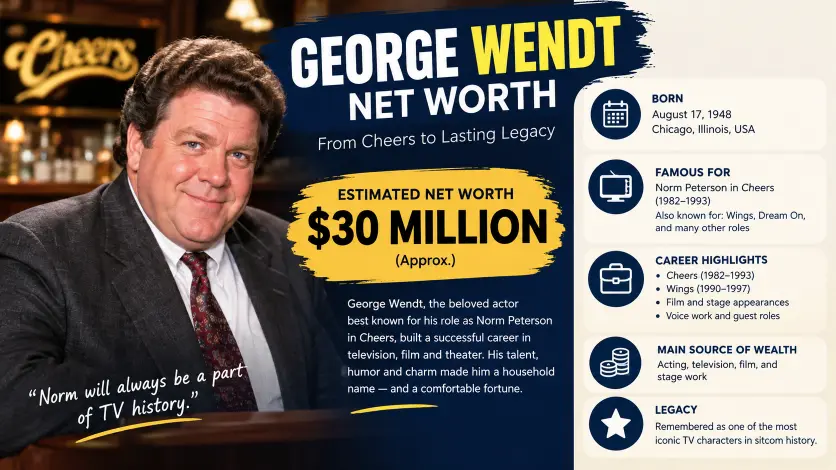
George Wendt remains closely associated with one of television’s most recognizable sitcom characters, Norm Peterson from Cheers. After spending years developing his comedy skills with Chicago’s Second City, Wendt became a household name when Cheers premiered in 1982. His performance continued throughout the show’s 11-season run and earned him six consecutive Primetime Emmy nominations.
When discussing George Wendt’s net worth, it is important to separate publicly documented career information from celebrity wealth estimates. Celebrity Net Worth has estimated that Wendt had approximately $10 million at the time of his death in May 2025. However, this figure was not a publicly audited financial statement, so it should be treated as an estimate rather than an exact figure. His decades-long work across television, movies, theater, comedy, and other entertainment projects provides important context for understanding how his career generated lasting financial value.
| Category | Details |
| Full name | George Robert Wendt |
| Born | October 17, 1948 |
| Birthplace | Chicago, Illinois, U.S. |
| Died | May 20, 2025 |
| Age at death | 76 |
| Profession | Actor and comedian |
| Best known for | Norm Peterson on Cheers |
| Cheers episodes | 275 |
| Primetime Emmy nominations | 6 |
| Reported net worth | About $10 million |
| Higher published estimate | About $25 million |
| Exact net worth | Not publicly verified |
Why George Wendt’s Net Worth Estimates Differ
Celebrity net worth figures should not be treated like audited financial statements. The commonly cited $10 million estimate comes from Celebrity Net Worth, which itself describes its figures as estimates.
The higher $25 million figure reported by Hindustan Times illustrates the uncertainty surrounding celebrity wealth estimates. Different calculations can include different assumptions about property, accumulated earnings, investments, taxes, expenses, residual income, and other assets.
For that reason, the safest description for George Wendt net worth in 2026 is that approximately $10 million is a widely reported estimate associated with his wealth at the time of his death, while the precise value of his estate remains not publicly verified.
How George Wendt Built His Wealth
1. Cheers Salary
The biggest financial chapter of Wendt’s career was undoubtedly Cheers, where he portrayed Norm Peterson from 1982 through 1993.
Celebrity Net Worth reports that Wendt eventually earned approximately $200,000 per episode, equivalent to around $5 million for a 25-episode season based on the calculation presented by the site.
However, salary figures reported decades later should be treated as estimates unless supported by the actor’s contracts or contemporaneous financial records. The available public sources do not provide Wendt’s complete salary history for all 11 seasons.
What is confirmed is the scale and longevity of his involvement: the Television Academy records that Wendt appeared in all 11 seasons of Cheers and received six Emmy nominations for Outstanding Supporting Actor in a Comedy Series.
2. Film Career
Wendt did not depend exclusively on television. His filmography included projects such as Airplane II: The Sequel, Fletch, Dreamscape, Guilty by Suspicion, Man of the House, The Little Rascals, Spice World, Lakeboat, and The Climb.
These film appearances provided another source of professional income while also extending his recognition beyond Cheers.
3. Television Roles After Cheers
After Cheers ended, Wendt continued working in television. He starred in The George Wendt Show in 1995 and later appeared in programs including Sabrina the Teenage Witch, Frasier, Family Guy, The Simpsons, Hot in Cleveland, Portlandia, and The Goldbergs.
His continued television work is important when examining his long-term financial profile because his career did not end when Cheers finished.
4. Stage and Broadway Work
Wendt also worked in theater. One notable achievement was playing Edna Turnblad in the Broadway production of Hairspray in 2008.
His stage career demonstrates that his professional income came from several areas of entertainment rather than from one television role alone.
George Wendt’s Career Timeline
| Year | Career milestone |
| 1970s | Joined Chicago’s Second City comedy community |
| 1980 | Appeared in My Bodyguard |
| 1982 | Debuted as Norm Peterson on Cheers |
| 1982–1993 | Appeared throughout Cheers‘ 11-season run |
| 1984–1989 | Received six consecutive Emmy nominations |
| 1995 | Starred in The George Wendt Show |
| 2008 | Played Edna Turnblad in Broadway’s Hairspray |
| 2010s | Continued film, television, and stage appearances |
| 2024 | Appeared in Love’s Second Act and reunited with Cheers cast members at the Emmys |
| 2025 | Died at age 76 |
| 2026 | Net worth remains an estimated historical figure rather than a publicly audited amount |
George Wendt’s Cheers Legacy
Wendt’s financial story cannot really be separated from Cheers. The sitcom premiered in 1982 and ran for 11 seasons, with Wendt’s Norm Peterson becoming one of its most recognizable recurring characters. The Television Academy confirms his six consecutive Emmy nominations from 1984 through 1989.
His character became so closely associated with the show that audiences routinely greeted Norm’s entrances with the famous “Norm!” response. Contemporary and retrospective coverage consistently identifies the character as Wendt’s defining television role.
Importantly, however, popularity does not automatically reveal the amount of money an actor personally retained. Gross earnings, taxes, agents’ commissions, living expenses, investments, and other financial factors all affect eventual net worth.
Did George Wendt Own Real Estate?
Celebrity Net Worth reported that Wendt and his wife purchased a Studio City home for $335,000 in 1985 and that the property was estimated at roughly $4 million around the time of his death.
That reported property value is one reason real estate may have been relevant to assessments of his overall wealth. However, property value is not the same thing as net worth: the calculation would also depend on ownership structure, outstanding debt, taxes, and other assets or liabilities.
Therefore, the property’s reported value should be viewed as part of the broader financial picture rather than proof that Wendt personally possessed $4 million in liquid funds.
George Wendt’s Final Years and Death
George Wendt remained associated with entertainment well after Cheers ended. His later work included television, film, and stage appearances, and he was part of a Cheers cast reunion at the 2024 Primetime Emmy Awards.
He died on May 20, 2025, at the age of 76. His family announced his death, while reports at the time said further details were not initially provided.
Because he died in 2025, references to George Wendt net worth in 2026 should be understood as referring to estimates of his wealth around the end of his life, not as a current personal income figure.
George Wendt Net Worth: What Can Actually Be Confirmed?
The most defensible financial conclusion is that George Wendt’s wealth was estimated at approximately $10 million by Celebrity Net Worth, while other publications reported higher estimates, including $25 million.
There is no publicly available, comprehensive audited statement that establishes his exact net worth. His long-running Cheers salary, decades of acting work, stage performances, property ownership, and other professional activities provide context for his accumulated wealth, but they do not allow an exact figure to be calculated from public information alone.
For SEO and factual accuracy, “$10 million estimated net worth” is therefore preferable to presenting a specific figure as an established fact.
George Wendt Net Worth: Income Sources
George Wendt’s career was built over five decades across television, film, theater, comedy, commercials, and voice work. He was best known for playing Norm Peterson on Cheers from 1982 to 1993, appearing throughout the sitcom’s entire run. The Television Academy records six consecutive Primetime Emmy nominations for his performance.
Because Wendt died in May 2025, discussions of his 2026 net worth should be treated as an estimate of his accumulated wealth rather than current employment income. Public sources do not provide a complete, audited breakdown of his lifetime earnings, Cheers salary, investments, property holdings, or estate value. Therefore, it is more accurate to examine the documented areas of his career that could have contributed to his wealth rather than present unsupported income figures.
1. Cheers Television Income
The most important part of George Wendt’s entertainment career was undoubtedly Cheers. He played Norm Peterson from 1982 through 1993 and appeared in every season of the series. The role transformed him from a Chicago stage performer into a nationally recognized television actor.
Wendt’s compensation for Cheers was not publicly documented in a complete, reliable year-by-year record. This is important because online articles sometimes repeat precise salary figures without providing primary documentation.
What can be established is that Wendt remained with the program for its entire 11-season run. As the show became a major television success, his long-term participation provided an extended source of professional acting income.
His earnings from the series would have included his contractual acting compensation, while any additional residual or royalty arrangements would depend on the contracts applicable to the production and later distribution. Without those contracts, it would be inappropriate to assign a specific lifetime amount to his Cheers income.
2. Television Guest Appearances
After Cheers, Wendt continued working in television for decades. His credits included appearances on programs such as Saturday Night Live, Frasier, The Simpsons, Family Guy, Portlandia, Hot in Cleveland, and other productions.
Guest appearances generally provide actors with additional professional income on a project-by-project basis. The amount depends on factors such as episode length, role size, contract terms, union arrangements, and production budget.
Wendt’s extensive television résumé therefore represents another important category of career earnings, although individual fees have generally not been publicly disclosed.
His continued television work was particularly relevant because it extended his earning career well beyond the conclusion of Cheers.
3. Film Acting Income
George Wendt also developed a substantial film résumé. His credits included Airplane II: The Sequel, Fletch, Gung Ho, The Little Rascals, Man of the House, Spice World, Forever Young, Outside Providence, and The Climb.
His film work provided another stream of acting income throughout his career.
Unlike a blockbuster lead whose salary may receive extensive media coverage, Wendt frequently worked as a supporting actor. Supporting performers can still accumulate substantial career earnings when they consistently obtain roles across multiple decades.
However, publicly available sources do not establish the exact amount Wendt earned from each movie. Consequently, individual movie salaries should not be invented or presented as confirmed facts.
4. Commercial and Advertising Work
Wendt’s association with Norm Peterson also made him recognizable outside traditional acting roles. Contemporary biographical sources note that his Cheers persona helped him secure commercial work, including advertising for a national brewery.
Commercial appearances can provide actors with additional income separate from television and movie salaries.
Depending on the campaign, compensation can involve a production fee, appearance fee, usage rights, or other contractual arrangements. The exact terms of Wendt’s advertising contracts have not been comprehensively published.
Therefore, commercial work should be considered a documented part of his professional activity, but not assigned a specific dollar amount without reliable financial documentation.
5. Theater and Broadway Income
Theater became another significant part of Wendt’s later career. He appeared in productions including Art, Hairspray, Elf, Breakfast at Tiffany’s, Death of a Salesman, The Odd Couple, and other stage productions.
One of his best-known Broadway roles came in Hairspray, where he played Edna Turnblad. He also performed as Santa in Elf the Musical and continued working in regional theater.
Stage income works differently from television or film compensation. Performers may receive weekly salaries during a production, with compensation depending on the production, theater, contract, and length of the engagement.
Wendt’s long-running involvement with theater demonstrates that his income sources were not dependent entirely on Cheers.
6. Second City and Comedy Career
Before becoming famous on television, Wendt spent years with Chicago’s Second City, one of America’s best-known improvisational comedy institutions.
The Second City records that Wendt joined its touring company and later performed on the Mainstage, beginning in the 1970s. He remained associated with the organization until leaving Chicago for Hollywood in 1980.
His early comedy work was important professionally because it developed the performance style that eventually helped him land television opportunities.
Financially, however, there is no reliable public record showing how much Wendt earned during each year at Second City. It should therefore be treated as an important career foundation rather than a source for a speculative dollar figure.
7. The George Wendt Show
Following Cheers, Wendt received an opportunity to headline his own television sitcom, The George Wendt Show, which aired in 1995.
Although the series did not become a long-running replacement for Cheers, starring in a network sitcom represented another major professional opportunity.
Actors leading their own television series generally negotiate compensation based on contracts, episode commitments, and production arrangements. Wendt’s exact compensation for the program has not been reliably documented in public financial records.
Consequently, it is safer to identify the show as another part of his professional earnings history rather than attach an unsupported salary figure.
8. Voice Acting and Animated Projects
Wendt also worked with animated productions and provided voice performances during his career. His television credits included animated projects such as Fancy Nancy, alongside guest appearances connected with other major entertainment franchises.
Voice acting can provide an additional income stream for established performers because the work does not require the same on-camera production process as live-action acting.
The financial value of these projects depends on the individual production and contractual arrangements. There is no comprehensive public record showing Wendt’s total lifetime voice-acting income.
Still, these roles demonstrate how his recognizable voice and comedic style remained commercially useful beyond Cheers.
9. Music Video and Special Appearances
Wendt also appeared in music-related and special entertainment projects. His credits included appearances connected with artists such as Ray Parker Jr. and Michael Jackson.
These projects were not the primary foundation of his wealth, but they added to an already broad entertainment résumé.
For established actors, one-off appearances can provide supplemental income while also maintaining public visibility.
Because compensation information for these appearances is generally unavailable, they should not be used to calculate an exact figure for Wendt’s net worth.
10. Saturday Night Live and Comedy Opportunities
Wendt’s Chicago comedy background became particularly useful when he appeared on Saturday Night Live. He became associated with the popular “Bill Swerski’s Superfans” sketches and returned to the program for comedy appearances.
His SNL appearances expanded his connection with audiences beyond Norm Peterson.
Such appearances could generate performance fees and potentially lead to additional opportunities, but public sources do not provide enough information to calculate his total SNL earnings.
The broader significance is that Wendt was able to monetize his recognizable comedic identity in several formats rather than relying exclusively on a single television role.
11. Touring and Live Performances
Wendt’s theater career also included touring productions. He participated in stage productions outside Broadway, including touring work and regional theater. AARP’s obituary notes his work in productions such as 12 Angry Men and other theatrical projects.
Live performances can generate income through weekly contracts, touring agreements, and production-specific compensation.
For an actor with a long career, these engagements can become an important supplementary income source, particularly between television and film projects.
Again, there is insufficient public financial information to determine exactly how much Wendt earned from touring.
12. Residuals and Long-Term Television Value
One potentially important element of an actor’s long-term financial picture is the continued distribution of older television programs.
Cheers remains a widely recognized television series, and Wendt’s Norm Peterson character was one of its central recurring personalities. The Television Academy confirms that he appeared throughout all 11 seasons.
Actors’ residual arrangements vary depending on contracts, union agreements, production circumstances, and the use of the program.
It would therefore be misleading to claim a specific annual residual amount for Wendt without documentation.
Nevertheless, the longevity of Cheers helps explain why the role remained an important part of his professional legacy decades after the show’s finale.
13. Character Recognition and Commercial Value
Norm Peterson became one of the defining characters of Wendt’s career. The role was so closely associated with him that his entrance on Cheers became a recurring comedic event.
This recognition had value beyond the original television series. It helped Wendt secure commercials, guest appearances, interviews, movie roles, and comedy opportunities.
The Second City describes how Wendt’s Cheers career was followed by extensive work on television, film, and stage.
However, character popularity should not automatically be converted into a dollar estimate. A famous role can create opportunities, but the financial outcome depends on contracts and actual payments.
14. Later-Career Acting
Wendt continued performing long after Cheers ended. His later film and television work included productions such as The Climb, The Goldbergs, Hot in Cleveland, and other projects.
This longevity matters when examining his overall financial career.
Rather than having a short period of fame followed by retirement, Wendt maintained professional activity across several decades. His career therefore included income opportunities at different stages of his life.
His later roles may not have generated the same level of public attention as Cheers, but collectively they demonstrate the breadth of his continued work.
15. Stage Productions After Television Fame
Wendt’s theater career continued even after he had become a recognizable television actor. His stage credits included both Broadway and regional productions.
AARP notes that he appeared in Broadway’s Hairspray, worked in Art, toured with 12 Angry Men, and performed in productions including Death of a Salesman.
This diversification is relevant to understanding his income sources.
For many actors, stage work is not simply a backup to television; it can be a separate professional career with its own contracts and audiences. Wendt’s repeated return to theater indicates that live performance remained an important part of his working life.
16. Producer and Other Entertainment Credits
Some databases list George Wendt with additional entertainment credits beyond acting, including producer-related work. TV Guide lists him professionally as an actor, soundtrack performer, director, and producer.
However, these secondary credits should not automatically be interpreted as major sources of wealth.
There is not enough reliable public evidence to determine whether producing or directing generated significant income compared with his acting career.
The safest conclusion is that Wendt’s financial career was primarily connected with his long-running work as a performer across television, film, theater, comedy, and related entertainment.
17. Cheers Legacy and Estate Considerations
Because George Wendt died in 2025, current discussions about his wealth also need to distinguish between personal net worth and the eventual value of an estate.
A celebrity’s estate can include property, investments, residual rights, contractual payments, personal assets, and other interests. Those details are not necessarily made public.
Therefore, an online estimate of George Wendt’s net worth should not automatically be treated as the exact amount ultimately passed to his heirs.
Public reporting confirms that Wendt died on May 20, 2025, at age 76.
18. Why Exact Income Figures Are Difficult to Verify
Celebrity net worth calculations often combine publicly reported information with estimates. For actors from earlier television eras, the problem can be even greater because original contracts and private financial records are generally not publicly available.
In Wendt’s case, reliable sources clearly document his acting history, but they do not provide a complete accounting of:
- Every Cheers salary
- Every residual payment
- Movie-by-movie compensation
- Commercial fees
- Theater salaries
- Investments
- Real estate holdings
- Taxes and expenses
- Estate arrangements
For this reason, a responsible George Wendt net worth article should distinguish between documented career income sources and estimated wealth figures.
19. The Role of Career Longevity
Longevity is one of the clearest themes in Wendt’s financial story.
He began working with Second City in the 1970s, reached mainstream television success with Cheers in the 1980s, and continued performing in television, film, and theater for decades afterward.
That career structure matters because wealth accumulation is not always created by one paycheck. A long working life can produce many separate contracts and opportunities.
Wendt’s career illustrates this pattern particularly well: comedy led to television, television led to film and commercial opportunities, and later decades brought theater and additional television work.
20. Overall Income Picture
George Wendt’s documented income sources were broad rather than limited to one profession. His major career categories included television acting, film acting, theater, comedy, commercials, voice work, guest appearances, and other entertainment projects.
His role as Norm Peterson on Cheers was the central professional milestone, but his decades of work afterward also contributed to his overall career earnings. The Second City, Television Academy, Reuters, AARP, and other reputable sources document the breadth and longevity of his career.
Because exact private financial records are unavailable, readers should treat published net-worth numbers as estimates. A fact-based article should avoid presenting an exact salary or wealth figure unless it can be traced to reliable documentation.
FAQs
1. What was George Wendt’s net worth?
Public celebrity-wealth estimates have placed George Wendt’s net worth at around $10 million, but this figure was not a publicly audited financial statement. It should therefore be described as an estimate.
2. How did George Wendt make his money?
His income came primarily from acting and entertainment, including Cheers, movies, television guest appearances, theater, commercials, voice work, and comedy performances.
3. How much did George Wendt make from Cheers?
His exact Cheers salary history has not been reliably published in a complete public record. He appeared throughout the show’s 11-season run.
4. What was George Wendt’s most famous role?
He was best known for playing Norm Peterson on the NBC sitcom Cheers, a role he played from 1982 to 1993.
5. Did George Wendt work outside television?
Yes. He had an extensive film career and also performed on Broadway and in regional theater. His stage credits included Hairspray, Elf, Art, and Death of a Salesman.
6. Was George Wendt nominated for an Emmy?
Yes. He received six consecutive Primetime Emmy nominations for Outstanding Supporting Actor in a Comedy Series for Cheers.
7. Was George Wendt still acting after Cheers?
Yes. He continued working in television, movies, and theater for decades after Cheers ended, with credits including The Climb, The Goldbergs, and various stage productions.
8. When did George Wendt die?
George Wendt died on May 20, 2025, at age 76, according to his publicist and major news organizations.
9. Did George Wendt have income from commercials?
Yes. Biographical sources note that his popularity as Norm Peterson helped lead to commercial work, including advertising for a national brewery.
10. Is George Wendt’s exact net worth publicly verified?
No. There is no publicly available audited financial statement establishing an exact lifetime net-worth figure. Online estimates should therefore be presented as estimates rather than confirmed financial facts.
Conclusion
George Wendt built his career and wealth through decades of work in television, film, theater, comedy, and commercial entertainment. His iconic role as Norm Peterson on Cheers became the foundation of his fame, while later acting and stage appearances helped extend his professional career.
Public estimates have placed his net worth at around $10 million, but this figure should be treated as an estimate because his complete financial records were never publicly audited. Wendt’s career demonstrates how a successful television role can create long-term opportunities across multiple areas of entertainment.
Although he passed away in May 2025, his performancesparticularly as Norm Petersoncontinue to remain part of television history. His lasting legacy comes not only from his estimated wealth but also from the decades of memorable work he contributed to comedy, television, film, and theater.