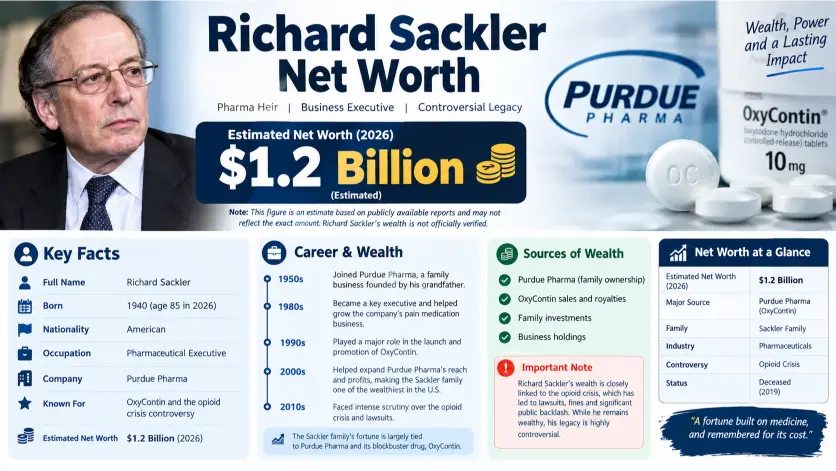
Richard Sackler’s net worth has remained a closely watched topic because of his long connection to Purdue Pharma and the Sackler family’s pharmaceutical fortune. As a former president and chairman of Purdue Pharma, Sackler became one of the most recognizable members of the family associated with OxyContin. Public estimates place his personal net worth at around $1 billion, but this figure is an estimate rather than an independently audited financial statement.
Understanding Richard Sackler’s wealth requires separating his personal finances from the much larger Sackler family fortune. Congressional documents released in 2021 estimated the combined family’s net assets at approximately $11 billion, based on bankruptcy-related financial presentations, while later reporting has shown that settlements and legal proceedings significantly affected the family’s finances. This article examines Richard Sackler’s estimated net worth, career at Purdue Pharma, potential sources of wealth, family assets, and the financial impact of the company’s legal and bankruptcy proceedings.
| Detail | Information |
| Person | Richard Sackler |
| Profession | Physician and pharmaceutical executive |
| Country | United States |
| Industry / Niche | Pharmaceuticals, medicine and business |
| Known for | Former leadership and ownership role at Purdue Pharma, the company associated with OxyContin |
| Status | Alive, based on currently available public information |
| Search intent | Informational + curiosity-driven |
| Ideal reader | Readers researching pharmaceutical-industry wealth, business history, Purdue Pharma, the Sackler family, and the financial impact of the OxyContin controversy |
Richard Sackler Net Worth 2026
Richard Sackler’s exact 2026 net worth is not publicly verified. Celebrity Net Worth currently lists an estimate of $1 billion, but this is an independent estimate rather than an audited personal financial statement.
The distinction is important because much of the publicly documented wealth associated with the Sackler family has been reported at the family level, rather than as Richard Sackler’s individually owned assets. A U.S. House Oversight Committee analysis of financial information submitted during Purdue Pharma’s bankruptcy proceedings estimated the Sackler family’s combined net assets at approximately $11 billion in 2021. That figure included cash, marketable securities, international drug-company interests, real estate, private equity and collectibles, and should not be treated as Richard Sackler’s personal net worth.
Richard Sackler Net Worth at a Glance
| Category | 2026 information |
| Estimated net worth | About $1 billion, according to Celebrity Net Worth |
| Official audited personal net worth | Not publicly verified |
| Profession | Physician and pharmaceutical executive |
| Former company | Purdue Pharma |
| Major business association | OxyContin |
| Sackler family assets reported in bankruptcy materials | Approximately $11 billion in a 2021 congressional analysis |
| Current personal income | Not publicly verified |
The $1 billion figure should therefore be presented as an estimate, not a confirmed fact.
Who Is Richard Sackler?
Richard Sackler is an American physician and former pharmaceutical executive who became one of the most prominent members of the Sackler family associated with Purdue Pharma.
Public legal records identify Sackler as having worked at Purdue beginning in the 1970s. He later held senior positions, including vice president of marketing and sales, senior vice president, and eventually president and CEO from 1999 to 2003.
His financial profile is closely connected to Purdue Pharma because the company was controlled by members of the Sackler family. The company’s most commercially significant product became OxyContin, an extended-release opioid introduced in the 1990s.
How Did Richard Sackler Build His Wealth?
Richard Sackler’s reported wealth is primarily associated with his career at Purdue Pharma and the broader financial interests of the Sackler family.
Unlike a modern celebrity whose income can be estimated from salaries, endorsements and public appearances, Sackler’s finances are much more complicated. His wealth historically involved private-company ownership, family trusts, distributions and investments, making it difficult to determine exactly how much belongs to him personally.
Court records examined during Purdue’s bankruptcy proceedings documented billions of dollars in distributions to Sackler family interests. One federal court opinion reported approximately $10.4 billion in distributions from Purdue to Sackler interests, including substantial amounts used for taxes.
Those figures describe family distributions, not Richard Sackler’s individual earnings.
Richard Sackler and Purdue Pharma
Richard Sackler’s career is inseparable from Purdue Pharma’s history.
According to Connecticut court filings, he began working for Purdue in the 1970s and subsequently moved into marketing and executive leadership. The filing identifies him as president and CEO from 1999 through 2003.
Documents released through litigation also provide evidence of his involvement in discussions surrounding OxyContin’s marketing. ProPublica reported on a 2015 deposition and previously sealed documents involving Sackler and Purdue executives.
These records are relevant to understanding why estimates of Sackler’s wealth are often discussed alongside Purdue Pharma’s financial history.
OxyContin and the Sackler Family’s Wealth
OxyContin became one of Purdue Pharma’s most financially important products. Court records later examined the company’s revenues, distributions and marketing practices during years of rapid growth.
A federal court opinion reviewing Purdue’s bankruptcy proceedings reported that Sackler family distributions from Purdue increased substantially after 2007 and that total distributions over a lengthy period reached approximately $10.4 billion.
ProPublica also reported that, during Richard Sackler’s deposition, he acknowledged that his family had made more than $1 billion from OxyContin sales but said he did not know whether the amount exceeded $5 billion.
This evidence helps explain why financial estimates connected to Richard Sackler can reach very high levels, but it still does not establish a precise personal net-worth figure.
Legal Settlements and Their Effect on Sackler Wealth
Legal settlements are an important part of any current discussion of Richard Sackler’s finances.
In 2020, the U.S. Department of Justice announced a civil settlement under which members of the Sackler family agreed to pay $225 million to resolve federal civil claims. The government also stated allegations concerning transfers of Purdue-related assets into family holding companies and trusts. The DOJ explicitly noted that the civil claims were allegations and that the settlement did not constitute a determination of liability for those claims.
The legal picture later changed significantly.
In 2024, the U.S. Supreme Court rejected provisions of an earlier Purdue bankruptcy arrangement that would have provided broad legal protections to the Sacklers. A new nationwide agreement was subsequently reached.
By May 1, 2026, a new $7.4 billion Purdue/Sackler settlement had become legally effective. State attorneys general reported that the agreement included contributions from the Sackler family and Purdue and would direct funds toward communities, individual victims and opioid-related programs.
Because the settlement involves family-level contributions and long-term financial obligations, it would be inappropriate to simply subtract the entire settlement amount from Richard Sackler’s estimated net worth.
Why Richard Sackler’s Net Worth Is Difficult to Verify
There are several reasons why online estimates can differ dramatically.
1. Private assets:
Much of the Sackler family’s wealth was historically connected to private companies, trusts and investment structures.
2. Family versus individual wealth:
A figure describing Sackler family assets cannot automatically be assigned to Richard Sackler.
3. Changing asset values:
Real estate, investments and private-company interests can change in value.
4. Legal obligations:
Settlements and other liabilities can affect wealth over time.
5. Lack of an audited personal balance sheet:
There is no publicly available, comprehensive statement showing all of Richard Sackler’s assets and liabilities.
For these reasons, “Richard Sackler net worth 2026: approximately $1 billion” is best understood as an online estimate rather than a verified financial fact.
Richard Sackler’s Career Timeline
| Period | Career development |
| 1970s | Began working with Purdue, according to court filings |
| 1990s | Advanced into senior leadership positions |
| 1996 | Purdue launched OxyContin |
| 1999–2003 | Served as Purdue’s president and CEO |
| 2000s | Continued involvement with Purdue and its ownership structure |
| 2015 | Gave a deposition concerning Purdue and OxyContin-related litigation |
| 2019 | Purdue filed for bankruptcy |
| 2020 | Federal government announced a $225 million civil settlement involving Sackler family members |
| 2024 | Supreme Court rejected broad legal protections contained in an earlier Purdue bankruptcy arrangement |
| 2026 | $7.4 billion Purdue/Sackler settlement became legally effective |
Career details are based on court and government records rather than estimates from celebrity-wealth websites.
Richard Sackler Net Worth vs. Sackler Family Wealth
One of the most common mistakes in articles about Richard Sackler is treating the family’s wealth as his individual fortune.
A 2021 U.S. House Oversight Committee analysis estimated the combined Sackler family net assets at approximately $11 billion based on financial information from Purdue’s bankruptcy proceedings.
That amount included multiple family branches and asset categories. It therefore cannot be used as a direct calculation of Richard Sackler’s personal wealth.
Similarly, reports about billions of dollars distributed by Purdue to Sackler interests describe family-level financial activity rather than a single individual’s paycheck.
What Is Richard Sackler’s Net Worth in 2026?
The most commonly cited public estimate is $1 billion, according to Celebrity Net Worth. However, there is no publicly verified audited figure confirming that Richard Sackler personally has exactly $1 billion in net assets.
The most responsible way to report the figure is:
Richard Sackler’s 2026 net worth is estimated at around $1 billion, but his exact personal net worth is not publicly verified.
This wording separates an online estimate from confirmed financial documentation.
Richard Sackler Net Worth 2026: Income Sources,
Richard Sackler’s wealth is closely connected to the Sackler family’s long ownership of Purdue Pharma, the pharmaceutical company associated with OxyContin. Unlike celebrities who disclose salaries, contracts, or business earnings through public filings, Sackler’s personal income has never been presented in a complete, independently audited public net-worth statement. As a result, any figure describing his individual net worth should be treated as an estimate rather than a confirmed financial fact.
The most important distinction is between Richard Sackler’s personal wealth and the combined wealth of the Sackler family. Congressional documents released in 2021 estimated the family’s combined net assets at approximately $11 billion at that time, including cash, securities, real estate, private-equity investments, international pharmaceutical interests, art, jewelry, and collectibles. Those figures were based on financial presentations prepared during Purdue Pharma’s bankruptcy proceedings, not on a current independent audit of Richard Sackler personally.
Historically, the principal economic source connected to Sackler wealth was ownership and distributions associated with Purdue Pharma. Court records show that Purdue generated very large distributions to Sackler family members over the years, particularly after 2007. In 2026, however, the financial picture is different because the Purdue settlement requires the Sackler family to contribute billions of dollars and relinquish its ownership interest in the company.
1. Purdue Pharma Ownership and Family Distributions
The most important historical source of Sackler wealth
The clearest documented connection between Richard Sackler’s wealth and income is Purdue Pharma.
The Sackler family had controlled Purdue Pharma since 1952. Richard Sackler became one of the family members deeply involved in the company’s management and eventually served as president and chairman. Purdue became enormously valuable as its pharmaceutical portfolio expanded, particularly after the launch and commercial success of OxyContin.
Because the Sackler family owned Purdue, profits generated by the company could ultimately benefit family members through ownership structures and distributions. This is different from saying that every dollar of Purdue revenue became Richard Sackler’s personal income. Company revenue, operating expenses, taxes, employee compensation, investments, and distributions are separate financial categories.
Court records provide an important indication of the scale of those historical distributions. A federal court document states that, over a particular period, Sackler family distributions from Purdue totaled approximately $10.4 billion, with about $4.6 billion used for pass-through taxes. The same document noted that Purdue’s distributions increased dramatically after 2007.
A 2026 Associated Press report, citing a 2019 audit, states that Sackler family members received approximately $10.7 billion in payouts from Purdue between 2008 and 2018. The report also says the family had not received distributions since 2018.
These numbers are family-level figures. They should not be interpreted as Richard Sackler personally receiving $10.7 billion.
Why ownership mattered
The economics of Purdue were important because the Sacklers were not simply employees of the company. They were its owners.
That ownership created several potential channels through which wealth could accumulate:
- Company distributions
- Ownership interests
- Investment of proceeds
- Family trusts and related structures
- Appreciation of financial assets
- Real-estate investments
- Other family-controlled businesses
Richard Sackler’s personal financial position therefore cannot be calculated simply by multiplying a reported executive salary.
A key difference between salary and ownership income
For a business owner, wealth can grow even when the individual does not receive a traditional salary equal to the company’s profits.
For example, if a privately held company generates substantial profits, its owners can potentially receive distributions while also retaining ownership of valuable assets. The owner’s wealth can therefore consist of both cash received historically and assets still owned.
That distinction is especially important when discussing Richard Sackler because publicly available documents focus heavily on the broader Sackler family’s finances rather than providing a complete personal balance sheet for him.
2. Executive Compensation at Purdue Pharma
Richard Sackler as a pharmaceutical executive
Another potential source of Richard Sackler’s income was compensation associated with his executive roles at Purdue Pharma.
Sackler was a physician by training and became an important executive within Purdue. Public reporting identifies him as a former president and chairman of the company, while court documents describe his involvement in the company’s business decisions.
Executive compensation can include considerably more than a basic salary. Depending on the corporate structure, it can involve:
- Base salary
- Bonuses
- Benefits
- Deferred compensation
- Retirement arrangements
- Equity or ownership-related benefits
- Other executive payments
However, there is no reliable public record establishing a complete lifetime compensation total for Richard Sackler that can be presented as a confirmed figure.
Therefore, an article about his income should avoid inventing an annual salary or presenting an unsupported compensation number.
Compensation versus family wealth
It is also important not to confuse Richard Sackler’s executive compensation with the money received by the Sackler family through ownership of Purdue.
An executive can earn millions through compensation while shareholders receive substantially more through ownership distributions. In Purdue’s case, the family’s ownership position was central to the accumulation of wealth.
This is why reports describing Sackler family distributions are more relevant to the historical wealth story than an isolated executive salary figure.
3. OxyContin and Purdue’s Pharmaceutical Business
How OxyContin changed Purdue’s finances
OxyContin became Purdue Pharma’s most commercially significant product.
The medication was introduced in 1996, and its sales eventually generated billions of dollars for Purdue. Court documents and investigative reporting have extensively examined the company’s marketing practices and the financial importance of OxyContin.
STAT reported that by 2006, OxyContin’s “profit contribution” to Purdue was approximately $4.7 billion, based on a document discussed during Richard Sackler’s deposition.
That number does not represent Richard Sackler’s personal income. Rather, it illustrates the scale of the business from which the Sackler family, as Purdue’s owners, benefited.
Family wealth versus product revenue
This distinction is critical for E-E-A-T-focused financial content.
If OxyContin generated billions of dollars in revenue or profit, that does not mean Richard Sackler personally earned the same amount.
The financial pathway was more complicated:
OxyContin sales → Purdue revenue → operating costs and taxes → corporate profit/cash flow → owner distributions and investments → family wealth
This is a much more accurate way to explain the historical relationship between OxyContin and Sackler wealth.
Why OxyContin remains relevant in 2026
OxyContin remains financially relevant to Richard Sackler’s net-worth story because much of the family’s historical wealth was built during the period when Purdue’s opioid business generated substantial cash.
A federal court record said the vast majority of Purdue’s earnings during 2008–2017 came from OxyContin sales.
However, the financial situation has changed substantially since Purdue entered bankruptcy proceedings.
4. Purdue Pharma Distributions
Large historical payouts
One of the most significant documented income channels for the Sackler family was money distributed by Purdue.
According to court records, Purdue’s distributions to the Sackler family became particularly large after 2007. The federal court record describes distributions totaling approximately $10.4 billion over the relevant period.
The 2019 audit cited by the Associated Press placed family payouts from Purdue from 2008 through 2018 at about $10.7 billion.
Again, these are family-level numbers.
There is no reliable basis for assigning a specific percentage of those distributions to Richard Sackler without additional verified financial records.
Why distributions matter more than salary
For a family that owns a major private company, distributions can be a much more significant wealth source than executive salaries.
The Sackler family’s Purdue ownership allowed wealth to move outside the company. Some of the money could then be invested or held through other assets and financial structures.
That helps explain why public estimates of Sackler family wealth historically included not only Purdue-related interests but also:
- Cash
- Marketable securities
- Hedge funds
- Brokerage accounts
- Real estate
- Private equity
- International pharmaceutical companies
- Art
- Jewelry
- Collectibles
The 2021 congressional analysis identified billions of dollars across these categories.
5. Investments and Financial Assets
Marketable securities and brokerage accounts
The Sackler family’s wealth was not limited to Purdue Pharma.
Documents examined by the U.S. House Committee on Oversight and Reform in 2021 estimated that the family held more than $2.9 billion in marketable securities, hedge funds, and brokerage accounts.
This is important because wealth generated through a private company can eventually be converted into diversified financial assets.
Once money is invested, potential returns may come from:
- Stock appreciation
- Bond interest
- Dividends
- Fund performance
- Private investments
- Capital gains
However, publicly available information does not provide a sufficiently detailed personal investment portfolio for Richard Sackler to calculate his individual annual investment income.
Why investment income is difficult to estimate
Suppose a person has $100 million invested.
A hypothetical 5% annual return could produce $5 million in investment gains or income, but that does not mean the person actually receives $5 million in cash.
Returns can come from:
- Unrealized asset appreciation
- Dividends
- Interest
- Realized capital gains
- Private investment distributions
Without a verified personal portfolio and tax information, assigning a specific investment-income figure to Richard Sackler would be speculative.
For that reason, investment income should be discussed as a potential historical wealth-building mechanism, not as a confirmed annual income figure.
6. Real Estate Investments
Family real-estate holdings
Real estate represented another significant component of the broader Sackler family’s wealth.
The 2021 congressional analysis estimated that the family held more than $1 billion in real estate at the time.
This included high-value properties associated with different members of the family and their various financial structures.
Real estate can generate wealth through several mechanisms:
- Property appreciation
- Rental income
- Long-term capital appreciation
- Strategic property sales
- Development or investment gains
But the available evidence does not establish that Richard Sackler personally earned a specific annual amount from rental properties.
Real estate as a wealth-preservation tool
For wealthy families, property can serve a purpose beyond generating rent.
A valuable property may appreciate significantly over decades, creating capital wealth even if it produces relatively little annual cash flow.
That means the value of a person’s real estate holdings can contribute significantly to net worth without appearing as regular “income.”
This distinction is particularly important in Richard Sackler’s case because his estimated wealth has historically been discussed alongside the much broader Sackler family asset base.
7. Private Equity and Other Investments
Private-equity interests
The congressional analysis of Sackler family finances also identified more than $1 billion in private-equity investments.
Private equity can generate returns through ownership stakes in privately held businesses, funds, and other investments.
Potential returns may include:
- Capital gains
- Distributions
- Dividends
- Sale proceeds
- Appreciation in the underlying businesses
But private-equity investments are often difficult for outsiders to value accurately because many are not publicly traded.
Why this matters for a net-worth estimate
If an individual owns a stake in a private company, the value of that stake can be uncertain.
Two analysts could assign different values to the same asset depending on:
- Comparable companies
- Recent transactions
- Expected future earnings
- Debt
- Market conditions
- Ownership percentage
Therefore, any website claiming to know Richard Sackler’s exact current investment income should be treated cautiously unless it provides verifiable documentation.
8. International Pharmaceutical Interests
Pharmaceutical assets beyond Purdue
The Sackler family’s wealth also extended beyond Purdue Pharma.
The 2021 congressional analysis estimated that the family owned more than $1 billion in international drug companies.
These holdings illustrate another potential source of family wealth.
A pharmaceutical company can create value through:
- Drug sales
- Intellectual property
- Licensing
- Distribution
- Manufacturing
- Business acquisitions
- Equity appreciation
However, the existence of family-level international pharmaceutical assets does not establish that Richard Sackler personally owned a particular percentage or received a specific annual income from them.
Avoiding an unsupported personal figure
For SEO content, it can be tempting to take a family asset figure and assign a portion to Richard Sackler.
That approach would not meet a strong fact-checking standard.
A better approach is to say:
Public records demonstrate substantial pharmaceutical and investment assets associated with the broader Sackler family, but they do not provide a complete current personal balance sheet for Richard Sackler.
That wording keeps the article informative without turning a family-level number into an unsupported personal claim.
9. Art, Jewelry and Collectibles
High-value personal and family assets
The congressional review estimated that the Sackler family possessed more than $250 million in art, jewelry, and other collectibles.
Such assets can contribute to net worth even when they do not produce conventional income.
For example, an artwork may appreciate over time without generating a salary, dividend, or rent.
The same applies to:
- Jewelry
- Rare collectibles
- Valuable personal property
- Other luxury assets
Wealth does not always mean monthly income
This category highlights an important principle when calculating net worth.
Net worth is generally:
Assets − Liabilities = Net Worth
It is not simply annual income.
A person can have a large net worth even if current annual income is relatively low, particularly if the individual accumulated valuable assets over many years.
Therefore, Richard Sackler’s historical wealth should not be understood only through the lens of a yearly paycheck.
10. Family Trusts and Financial Structures
Complex ownership arrangements
Another reason Richard Sackler’s exact net worth is difficult to determine is the use of family financial structures.
Reporting and court proceedings have described trusts, companies, partnerships, and other entities associated with Sackler family finances.
CBS News reported that money removed from Purdue was associated with various financial entities and that questions arose regarding where portions of those funds were ultimately held.
These structures can make personal wealth calculations more complicated.
An asset may be:
- Owned directly
- Held through a trust
- Owned by a company
- Shared among family members
- Held through an investment vehicle
Why public estimates vary
This is one reason different websites can report dramatically different Richard Sackler net-worth figures.
Some estimates may:
- Use historical family wealth.
- Assign a portion of family assets to Richard.
- Include investment appreciation.
- Use outdated Purdue ownership assumptions.
- Fail to account for legal settlements and liabilities.
A credible article should therefore clearly label estimates as estimates.
11. Wealth Generated Before Purdue’s Bankruptcy
The pre-bankruptcy period
Richard Sackler’s financial story changed significantly when Purdue Pharma filed for bankruptcy protection in 2019.
Before bankruptcy, Purdue remained controlled by the Sackler family and had generated enormous cash flows.
The family’s withdrawals from Purdue became a central subject of litigation and public scrutiny.
The 2026 Associated Press report notes that the Sacklers received approximately $10.7 billion from Purdue between 2008 and 2018, with no distributions after 2018.
This provides an important timeline:
Before 2007: Purdue was profitable and distributed money to its owners.
2007–2018: Distributions to the Sacklers increased substantially.
2018: Family distributions reportedly ended.
2019: Purdue entered Chapter 11 bankruptcy.
2024: The U.S. Supreme Court rejected an earlier settlement structure involving releases for the Sacklers.
2026: A revised settlement became effective, with the Sacklers contributing billions and giving up their Purdue ownership.
This timeline is essential when discussing Richard Sackler’s current financial position.
12. The 2026 Purdue Settlement and Its Financial Impact
A major change in Sackler wealth
The biggest recent development affecting the family’s financial position is the Purdue settlement that became effective in 2026.
The Massachusetts Attorney General’s Office reported that the $7.4 billion settlement with Purdue and the Sackler family became legally effective on May 1, 2026.
The settlement includes substantial contributions from the Sacklers.
The Washington Post, citing Associated Press reporting, reported that at least $6.5 billion of the settlement would come from members of the Sackler family, while the family would give up its interest in Purdue.
Why the settlement changes net-worth calculations
A person’s net worth can decline when significant liabilities or settlement obligations are taken into account.
Therefore, an old estimate of Richard Sackler’s wealth should not automatically be treated as his current 2026 net worth.
Historical estimates may have been calculated before:
- Settlement payments
- Loss of Purdue ownership
- Changes in asset values
- Legal expenses
- Investment returns
- Other liabilities
were fully reflected.
This is why a responsible 2026 article should use phrases such as “estimated,” “reported,” and “not independently verified.”
13. Was Richard Sackler Still Earning Money From Purdue in 2026?
No confirmed current Purdue income
There is no reliable evidence that Richard Sackler continues to receive ordinary owner distributions from Purdue Pharma in 2026.
The situation is fundamentally different from the period when the Sackler family controlled the company.
Under the 2026 settlement, the family’s ownership interest is being relinquished, while Purdue’s operations are transferred into a new public-benefit structure.
Therefore, an article should not describe Purdue Pharma distributions as an ongoing 2026 income stream for Richard Sackler.
Historical income versus current income
This distinction can be summarized as:
| Income/wealth source | Historical relevance | Current 2026 status |
| Purdue ownership | Very significant | Ownership relinquished under settlement |
| Purdue distributions | Major historical source | No distributions reported since 2018 |
| Executive compensation | Relevant historically | No verified current Purdue salary |
| OxyContin-related business profits | Major historical driver of Purdue value | Historical rather than current personal income |
| Investments | Potential wealth source | Exact personal portfolio not publicly verified |
| Real estate | Family wealth component | Individual holdings/income unclear |
| Private equity | Family wealth component | Individual holdings not fully public |
| Art/collectibles | Family asset category | Individual ownership unclear |
| International pharmaceutical interests | Family wealth component | Exact Richard Sackler share unclear |
| Settlement obligations | Not an income source | Major current financial consideration |
The table demonstrates why simply stating a single number for “Richard Sackler income” would be misleading.
14. Richard Sackler’s Net Worth: What Can Actually Be Verified?
The $1 billion estimate
Some celebrity-wealth websites currently place Richard Sackler’s personal net worth at approximately $1 billion.
That figure should be described as an estimate, not an audited balance-sheet figure.
There is no publicly available personal financial statement that independently confirms an exact $1 billion personal net worth for Richard Sackler.
The $11 billion figure
The frequently cited $11 billion figure refers to the combined Sackler family wealth, not Richard Sackler alone.
The U.S. House Oversight Committee said in 2021 that documents from the Purdue bankruptcy proceedings showed approximately $11 billion in total family net assets.
Therefore:
Richard Sackler ≠ $11 billion personally
and
Sackler family ≠ Richard Sackler alone.
This distinction should remain clear throughout any article discussing his finances.
15. How Richard Sackler’s Wealth Was Built
When the available evidence is placed together, the historical wealth-building model looks roughly like this:
Step 1: Family ownership
The Sackler family controlled Purdue Pharma for decades.
Step 2: Pharmaceutical growth
Purdue developed and sold pharmaceutical products, with OxyContin becoming its most commercially important product.
Step 3: Increased company profitability
OxyContin generated substantial revenue and profit for Purdue.
Step 4: Owner distributions
Money was distributed from Purdue to members of the Sackler family.
Step 5: Diversification
Family wealth expanded beyond Purdue into securities, real estate, private equity, pharmaceutical interests, art, jewelry, and other assets.
Step 6: Legal and financial restructuring
Purdue entered bankruptcy, and the family’s finances became subject to extensive litigation and settlement negotiations.
Step 7: 2026 settlement
The Sacklers agreed to contribute billions and surrender their ownership interest in Purdue as part of the settlement that became effective in 2026.
This sequence provides a more accurate explanation than simply saying Richard Sackler “earned billions from OxyContin.”
16. Richard Sackler Income Sources: A Fact-Checked Breakdown
Purdue Pharma ownership
Historically, this appears to have been the most important wealth-generating connection.
Executive compensation
His leadership roles at Purdue likely provided compensation, but a complete verified lifetime compensation figure is not publicly available.
Owner distributions
Court records demonstrate that very large distributions went to the Sackler family, although the exact amount attributable to Richard Sackler personally is not established in the public record reviewed here.
Investment returns
The wider family held billions in marketable securities, hedge funds, brokerage accounts, and private-equity investments, creating potential investment returns.
Real estate
Real estate formed another major family asset category, although Richard Sackler’s exact personal property portfolio is not fully public.
Pharmaceutical investments
The family held interests in international pharmaceutical businesses, according to the congressional financial analysis.
Art and collectibles
Art, jewelry, and collectibles represented another significant family asset category.
17. Why Exact Income Numbers Are Unavailable
Private-company finances
Purdue Pharma was privately held, meaning its owners were not required to provide the same kind of public financial disclosure associated with publicly traded companies.
Family-level reporting
Many public documents discuss the Sackler family collectively rather than Richard Sackler individually.
Trusts and companies
Assets can be held through entities rather than directly by an individual.
Changing asset values
Investments and property change in value over time.
Legal obligations
The Purdue settlement creates substantial financial obligations that affect the family’s current wealth.
For these reasons, a precise annual-income figure for Richard Sackler cannot responsibly be presented without additional verified financial documentation.
18. What Happened to the Sackler Family Fortune?
The family’s fortune became the subject of extensive legal scrutiny following lawsuits concerning Purdue Pharma and OxyContin.
In 2021, the House Oversight Committee published an analysis estimating the family’s net assets at approximately $11 billion.
Later estimates changed as analysts incorporated settlement liabilities and other financial developments.
Forbes reported in 2024 that the family had substantial cash and liquid securities but that estimates of net worth varied depending on how pending settlement obligations were treated.
The 2026 settlement adds another major change.
The family is required to make substantial payments, while Purdue is no longer controlled by the Sacklers.
Consequently, historical wealth estimates should not be copied into a 2026 article without explaining their date and methodology.
19. The Difference Between Net Worth and Income
This is one of the most important concepts for readers researching Richard Sackler.
Income is money received during a particular period.
Net worth is the value of assets minus liabilities.
For example, a person could have:
- $100 million in investments
- $20 million in real estate
- $5 million in cash
- $10 million in liabilities
Their net worth would be approximately $115 million.
That does not mean they earn $115 million every year.
Similarly, the Sackler family’s historical $11 billion asset estimate does not mean Richard Sackler or every family member earned $11 billion in annual income.
This distinction should be maintained throughout any financial article.
20. Richard Sackler Net Worth 2026: The Bigger Financial Picture
Richard Sackler’s financial story cannot be separated from the history of Purdue Pharma.
His wealth was historically connected to:
- Family ownership of Purdue
- Executive involvement in the company
- Owner distributions
- Pharmaceutical profits
- Investment diversification
- Real estate
- Private equity
- Other family-controlled assets
However, the financial picture changed substantially after Purdue’s bankruptcy and the subsequent legal settlements.
The 2026 settlement is particularly important because it requires the Sackler family to provide billions of dollars and give up its ownership interest in Purdue.
Therefore, older articles that simply repeat a historical estimate without discussing these developments may provide an incomplete picture of Richard Sackler’s finances.
FAQs
1. What is Richard Sackler’s net worth in 2026?
Richard Sackler’s exact personal net worth is not publicly verified through an audited financial statement. Some wealth-estimate websites place his fortune around $1 billion, but that number should be treated as an estimate rather than a confirmed figure.
2. How did Richard Sackler make his money?
His wealth is primarily associated with his family’s ownership of Purdue Pharma, his executive roles at the company, historical distributions to Sackler family members, and the family’s broader investments and assets.
3. Did Richard Sackler own Purdue Pharma?
Richard Sackler was a member of the Sackler family that controlled Purdue Pharma. The family owned the company for decades. Under the 2026 settlement, the family relinquished its ownership interest in Purdue.
4. Did Richard Sackler receive money from Purdue Pharma?
Public court records document very large distributions from Purdue to the Sackler family. However, publicly available evidence does not establish a precise amount personally received by Richard Sackler.
5. How much did the Sackler family receive from Purdue?
A 2019 audit cited by the Associated Press reported approximately $10.7 billion in payouts to Sackler family members from 2008 through 2018. This was a family-level figure, not Richard Sackler’s personal income.
6. Is the Sackler family still receiving Purdue distributions?
The Associated Press reported that the family had not received Purdue distributions since 2018. The 2026 settlement also ends the family’s ownership of Purdue.
7. Was Richard Sackler a billionaire?
Some public wealth-estimate sources describe Richard Sackler as a billionaire, but his exact personal wealth has not been independently audited and publicly confirmed. The frequently cited $11 billion figure refers to the combined Sackler family wealth, not Richard Sackler alone.
8. What were the Sackler family’s major assets?
A 2021 congressional analysis identified cash, marketable securities, hedge funds, brokerage accounts, real estate, private equity, international pharmaceutical companies, art, jewelry, and collectibles among the family’s assets.
9. Does Richard Sackler still own Purdue Pharma in 2026?
No. The 2026 settlement provides for the Sackler family to relinquish its interest in Purdue, with the company transitioning into a new public-benefit structure.
10. Why is Richard Sackler’s exact net worth difficult to calculate?
His personal finances are not fully public, much of the available documentation concerns the Sackler family collectively, assets may be held through various entities, investment values change, and the family’s financial obligations have changed substantially because of the Purdue settlement.
Conclusion
Richard Sackler’s wealth is best understood as part of the broader financial history of the Sackler family’s ownership of Purdue Pharma rather than as the result of a conventional executive salary. His career at Purdue gave him an important leadership position, while the family’s ownership allowed members to benefit from company distributions and build wealth in other asset categories. Court records document billions of dollars in historical distributions to the Sackler family, but those figures should not be presented as Richard Sackler’s personal earnings.
The often-reported $1 billion personal net-worth estimate remains unverified, while the approximately $11 billion figure documented by Congress represented the combined family net assets at the time of its 2021 analysis. In 2026, the financial picture has changed substantially because the Purdue settlement requires billions in family contributions and ended the Sacklers’ ownership of Purdue.
For readers researching Richard Sackler net worth 2026, the most accurate conclusion is therefore that his exact personal fortune is not publicly established. His historical wealth is strongly associated with Purdue ownership, family distributions, investments, and diversified assets, while current wealth must account for the family’s substantial settlement obligations